
About ETS
Home About ETS Tools Lectures Customers Compass
- Speaker     - Type     - Seminars     - Attendee's Comments

Designing Plastic Parts for Assembly
2-days Seminar: December 10 and 11, 2008.
Seminar Hours: 8:30 a.m. - 4:30 p.m. (registration first day at 8:00 a.m.)
Grand Valley State University - Eberhard Center (click here for written directions)
301 West Fulton Street, Room 210
Grand Rapids MI 49504-6495 USA
To register click HERE

Instructor
This two-days in-depth assembly seminar will provide information on material selection, design procedures, processing techniques, and the assembly methods required when designing with plastics.
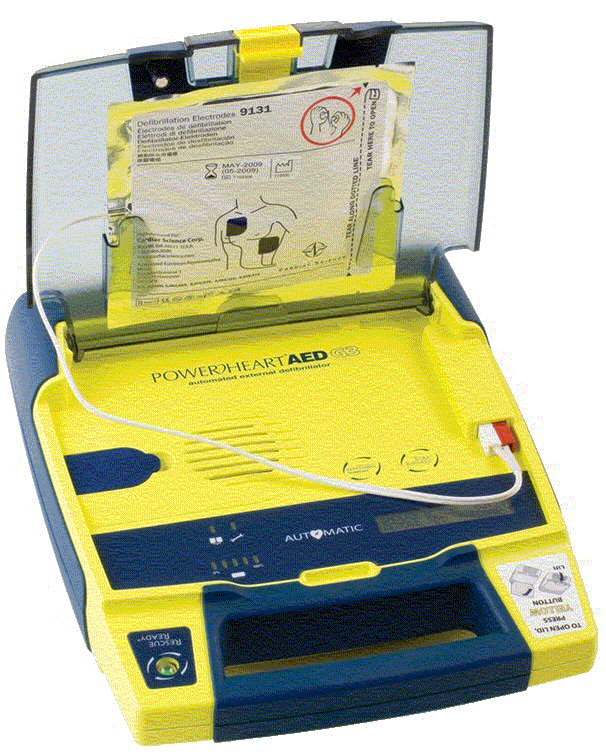
Defribilator
This course will make material selection, design procedures and methodologies, processing techniques, and assembly methods easier to use. It will increase your understanding of what to expect from a plastic resin. It will provide a detailed discussion of methods and a step-by-step methodology used to make the design process as easy as possible.
Upon the completion of this course you will have learned:
►►► Understand advanced concepts for plastic system and component design
►►► How to define and use safety factors
►►► Determine the optimum assembly method
►►► Utilize commercially available software for plastic part design
►►► How to select materials
►►► Behavior of plastic resins

Designing for assembly and manufacturing has always been an important task for designers, engineers and all other involved in product development. A new emphasis has been placed on design over the last few years as designing for manufacturing and assembly (DFMA) has become a significant manufacturing trend around the world. Yet, until now, no system of design for plastics has been developed specifically for the DFMA process. This course fills that void by showing how plastics parts and systems can be designed to incorporate the benefits of DFMA.

Ideal Learner
The content of this course is intended to provide a design process that optimizes today’s plastic materials for modern manufacturing systems.

The seminar is presented in two major sections. The first reviews the physical and mechanical properties of polymers, how to select the best resin for a given application. The important area of safety factors is discussed. The second section deals with specific assembly and design techniques.

Special emphasis is given to the examination of welding and bonding methods, press-fitting assemblies, reduction of components by integrating them by means of living hinges and snap-fitting assemblies. 

Plan to attend and come prepared with questions to ask or experiences to share.

Seminar Outline
Plastics Resins
Thermoplastics & Thermosets
Structures: Crystalline, Amorphous, Liquid Crystal Polymer
New Polymer Technologies
Reinforcements & Fillers
Additives
Physical Properties: Density, Specific Gravity, Elasticity & Plasticity
Notch Sensitivity, Isotropic & Anisotropic, Water Absorption
Mold Shrinkage
Mechanical Properties: Stress, Strain, Stress-Strain Curve
Thermal Expansion
Creep, Creep Curves, Creep Modulus
Stress Relaxation

Safety Factors
What Is a Safety Factor?, Design Safety Factors, Design Static Safety Factor
Design Dynamic Safety Factor, Design Time Related Safety Factor
Material Properties Safety Factor, Processing Safety Factor
Operating Condition Safety Factor

Plastic Part Design
Tensile, Compressive, Shear & Torsion Stresses
Tensile, Compressive & Shear Strains
Proper Part Design: Boss Design, Minimum Hole Distance, Ribbing
Rib Dimensions, Ribbed Example
Wall Stock, Thin Wall, Minimum Injection Pressure, Cavity Pressure Vs. Clamping Force,
Knockout Design, Draft Angles, Texturing
Poisson’s Ratio, Modulus of Elasticity: Young’s, Tangent, Secant & Flexural
Apparent (Creep) Modulus, Shear Modulus, Use of Various Moduli

Non-Linear Properties
Material Considerations, Linear & Non-Linear Material
Geometry Considerations, Linear & Non-Linear Geometry
Finite Element Analysis, FEM Method Application, Using FEM Method
Most Common FEA Codes
Case History: Bullet Plastic Jacket
Design Tools: iSight, BMX (Behavioral Modeling), TRIZ (Altshuller)

Ultrasonic Assembly Techniques
Welding, Ultrasonic Equipment, Process, Types of Vibrations, Cycle
Control Methods: Constant Time & Constant Energy, Constant Travel (Partial)
Constant Travel (Total), Horn Materials, Far-Near Field
Fixtures, Case History: Pall 5 µm Precipitate Filter
Joint Design: Shear Joint Design, Variations of Shear Joint Design
Flash Traps Designs, Energy Director or Tongue & Groove Design, Step Joint Design,
Variations of Butt Joint Design, Heat Staking Assembly Techniques
Case History: Capsela - PlayJour International
Ultrasonic Staking Design: Standard, Flush, Spherical, Hollow & Knurled Design
Ultrasonic Swaging, Ultrasonic Stud Welding
Joint Design: Round Solid Post, Round Hollow Post, Cross Post, Angled Post

Spin Welding
Equipment, Methods: Pivot & Inertia, Spin Welding Process
Joint Design: Thin Walls Joint Design & Medium Walls Joint Design
Plug Design for Spin Welding, Taper/Tongue & Groove, Shear/Flat Shear,
Reverse/Vertical, Double Vertical/Vertical Curved, Horizontal/Step with
Flash Trap, Step/Step with Energy Director

Hot Plate Welding
Process, Parameters & Features, Advantages & Disadvantages
Joint Design: Butt Joint Design, Recessed Joint with Flash Trap
Butt Joint Design with Flash Traps, Case History: Washer Fluid
Bottle – Mercedes-Benz M-Class
, Hot Plate Welding: Strength Capability

Vibration Welding
Equipment, Process, Advantages & Disadvantages
Vibration Welding Phases, Cross-Thickness Vibration Welding
Applied Pressure, Friction Force, Joint Design for Vibration Welding
Classical Joint Design, Bench Flash Trap/Straight Bench, Ridged Double
Grooved Bench, Double L Flash Traps/Dovetail

Electromagnetic Welding
Equipment, Process, Induction Coil Types Materials, Bonding Agent
Joint Design: Tongue Groove, Step Joint, Joint Design Formula, Double Joint
Groove Joint, Tongue and Groove Variation
Case History: Mitsubishi - Power Steering Fluid Reservoir,
Step Joint Variation , 3-Piece Joint, Advantages & Disadvantages

Laser Welding
Equipment, Process: Surface Heating, Through Transmission Staking,
Single Movement Mode, Double Movement Mode, Scanning Localized Heating,
Continuous Illumination, Staking, Mask Welding, Examples

Bonding
Failure Theories, Drafting Symbols, Substrate Wettability Tests
Contact Angle Test, Surface Energy, Cleaning the Substrate
Abrasive Methods, Substrate Chemical Treatment
Corona Treatment & Schematic, Portable Corona Unit
Plasma Treatment, Flame Treatment, Treatment Selection Criteria
Bonding Stresses, Case History: Chrysler Concept Vehicle
Joint Design: Joggle Lap, Double Scarf Joint, Butt Scarf Lap
Tongue and Groove, Simple Lap, 3-Plate Tongue and Groove
Stress Cracking, Polymer Behavior, Designs for Stress Cracking

Press Fits
Material Properties, Geometric Definitions, Safety Factors, Creep Loads,
Press Fit Theory, Design Algorithm
Case History: Cassette Deck, Resin Properties Shaft: Stress-Strain
Curve @ 73F & 200F, Creep Curves @ 73F & 200F, Resin Properties Pulley:
Stress-Strain Curve @ 73F & 200F, Creep Curves @ 73F & 200F
Solution: Case A, B, C & D
Case History: Chrysler 300M - High Output 3.5L 60 degree V-6 Engine
Fusible Core Injection Molding, Process, UIM Background, Design Requirements,
Press Fit Detail, CAMPUS Database, Material Properties:
PA66, 35%GR - DAM & 50%RH, T = -40C, +23C, & +120C at time = 0 hrs
Algorithm, Interference Necessary, Interference Available @ 120C
Interference @ -40C, Stress @ -40C, +23C & +120C at time=5,000 hrs
Case History: Indeflator

Living Hinges
Design for PP, PE, Common Designs, Design for Engineering Plastics
Elastic Strain Due to Bending, Geometry, Hinge Closing Angle
Hinge Bending Radius, Plastic Strain Due to Pure Bending
Strain Due to Bending, Plastic Strain Due to Bending & Tension
Tension Strain, Tension Bending Strain, Neutral Axis Position
Hinge Length, Elastic Portion of Hinge Thickness
Case History: World Class Connector, Initial Material (PA6)
Proper Assembly Motion, Improper Handling, Production Material (PET),
Proper Assembly Motion, Improper Handling, Yield Criteria
Case History: Ignition Cable Bracket, Molding Hinges, Sequential Gates
Processing Issues, Coined Hinges, Coining Process
Case History: Gun Holster
Oil Can Principle, Exercise: Crib - Living Hinge Design

Snap Fits
Material   Design Consideration, Assembly Positioning, Datum Lines
Safety Factors, Cantilever Snap-Fits: One-way & Two-way
Analysis Types for Cantilever Snap-Fits, Snap Fit Theory, Geometric Relations
Stress Strain Curve   Formulae, Instantaneous Moment of Inertia
Angle of Deflection, Equation of Deflection
Case History: HP Notebook
Maximum Deflection, Self-Locking Angle, Case History: Material Properties,
FEA Model, Magnitude of Error, Annular Snap-Fit, Shallow Groove, Deep Groove,
Angle of Assembly, Torsional Snap-Fits, Round Solid, Round Hollow , Square Solid,
Triangular, Case History: Formulas, Material Properties, Locators/Restrictors,
Orienting Guides, Crash Ribs, Darts, Limiters, Spring Rate, Over-deflection,
Bridge Design, Angled Tab Design, Tab Design, Springs
Disassembly Symbols, Thumb Depression, Recycling Symbols Convention,
Disassembly Assists, Hidden Features
Case History: Medication Dispensing Bottle
Tooling for Snap Fits, Issues with Snap Fitting
Snap Fit Software
Plastic Part Design on the World Wide Web
Free review of attendees' projects


Top  Top


Legal Notice Privacy Policy Contact Feedback Site Map
©2009 ETS Inc. All rights reserved